
A $1.1B Seed Round. No Product. No Revenue. No Roadmap. Investors Lined Up Anyway.
When the man who taught a machine to beat the world at Go raises a billion dollars before writing a line of code, pay attention.


A startup with no product, no revenue, and no published roadmap just raised $1.1 billion at a $5.1 billion valuation. At the seed stage.
That’s not a typo.
Ineffable Intelligence, a London based AI lab, emerged from stealth yesterday with the largest seed round ever raised in Europe. CNBC The round was co-led by Sequoia and Lightspeed, with participation from Nvidia, Google, DST Global, Index Ventures, EQT, and the UK government’s own Sovereign AI Fund. Pathfounders
The founder is David Silver, the former lead of DeepMind’s reinforcement learning team and a UCL professor. CNBC He’s the person behind AlphaGo, the system that beat the world’s best Go players in 2016 and genuinely changed how researchers think about machine intelligence.
His thesis for Ineffable is a direct challenge to the current AI consensus. Rather than training on human-generated text like most large language models, Ineffable is building a “superlearner” an AI system that discovers knowledge through trial and error, without relying on human data at all. TechCrunch Silver’s stated mission: “make first contact with superintelligence.” CNBC
There’s one more detail worth flagging. Silver has publicly committed to donating 100% of his personal equity gains to high-impact charities via the Founders Pledge. TechCrunch He’s not doing this for the exit.
Mental Model: Betting on the Jockey, Not the Horse
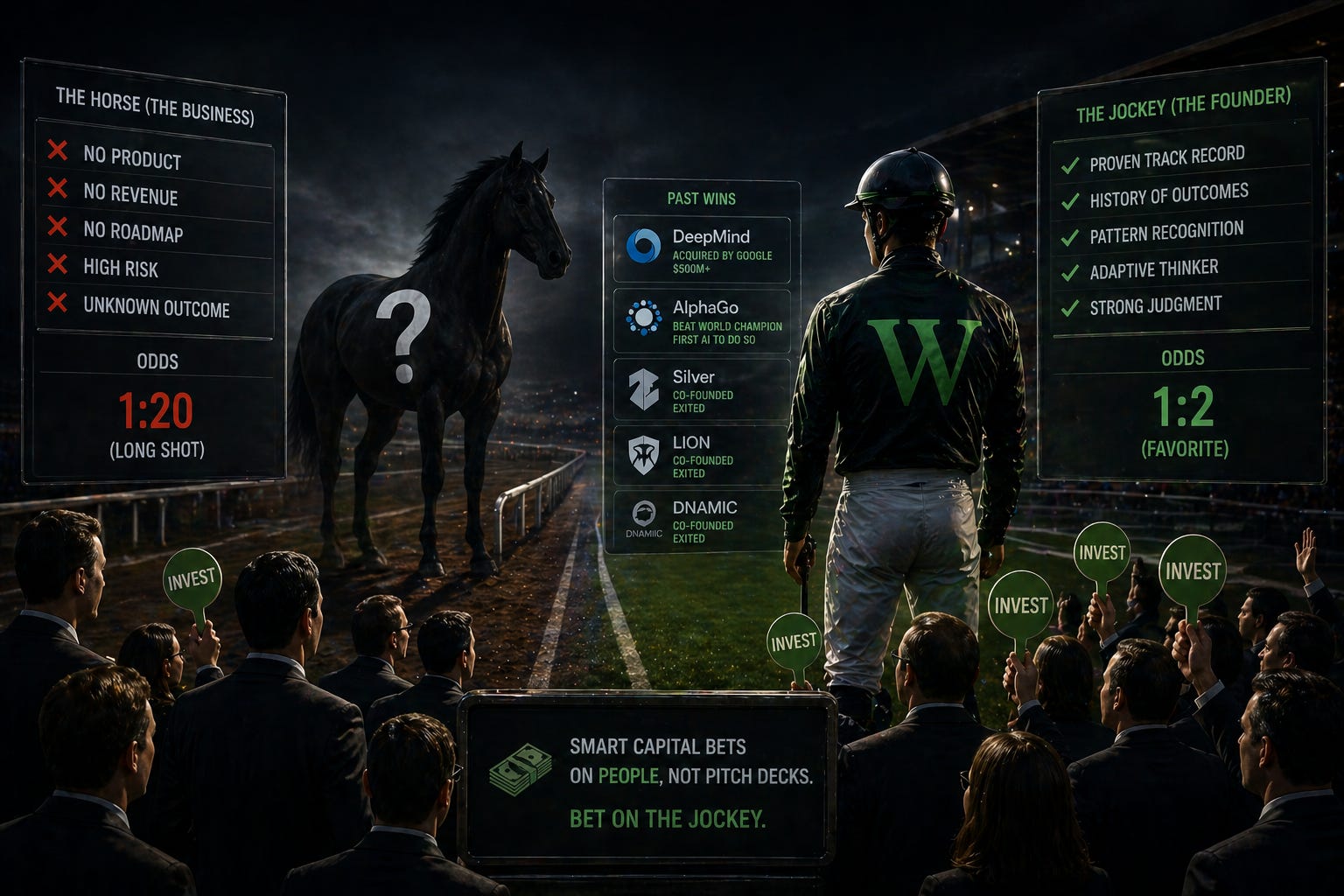
In venture capital, there’s a long-running debate: do you back the idea or the person? Most experienced investors will tell you it’s almost always the person, especially at the earliest stages when there’s no product to evaluate.
Ineffable Intelligence is that model operating at full intensity. The company has yet to release a product, generate any revenue, or publish a roadmap for what it intends to build. Yahoo Finance Sequoia and Lightspeed didn’t fund a deck. They funded David Silver’s track record, his scientific worldview, and their conviction that whoever solves reinforcement learning at scale builds something no LLM can replicate.
The horse doesn’t exist yet. The jockey has won every race he’s entered.
This model cuts both ways. Betting on the jockey works when the jockey is genuinely singular someone with a track record that’s not just strong but demonstrably different from everyone else in the field. It fails when investors confuse pedigree with results, or when the market context changes faster than the founder can adapt.
Silver’s edge is that reinforcement learning at scale is his specific area. He’s not pivoting into AI from something else. He built AlphaGo. He built AlphaZero. This is his career’s work, and now he’s betting the rest of his career and his entire financial upside on proving it can go further than any LLM.
That’s a different kind of founder signal.
Spencer’s Take
Here’s the contrarian read nobody’s saying out loud: this round is also a bet against OpenAI’s architecture.
Silver’s whole premise is that scaling LLMs on human data hits a ceiling and that the next leap comes from machines learning from experience, not from ingesting more of the internet. His argument is that creating bigger chatbots via LLMs is a dead end, and that whoever cracks scalable “experience loops” gets a compounding platform that isn’t bottlenecked by human knowledge. Pathfounders
If he’s right, OpenAI’s $852 billion valuation is built on the wrong foundation.
If he’s wrong, $1.1 billion becomes a very expensive PhD dissertation.
I’ve spent enough time building in regulated, capital-intensive markets from derivatives infrastructure at Robinhood to athlete tokenization at /mkt to know that the most important bets often look ridiculous before they look obvious. The LLM consensus is real, well-funded, and deeply entrenched. Those are exactly the conditions that produce the biggest blind spots.
I’m not saying Silver’s right. I’m saying the investors who backed him aren’t idiots, and the rest of us should probably understand why they did it before dismissing it.
Watch the jockey.
If this was useful, share it with someone who builds things. And if you want the full toolkit of 50 mental models, my book is coming soon.